 Mogilev
 Where your ancestors came from
«Mogilev» on an old document can mean a city, a district or an entire province. Here is how to tell which one, and where it is today.
The Mogilev Governorate was a province of the Russian Empire from 1772 until 1919. At the 1897 census it had about 1.7 million inhabitants, roughly one in eight of them Jewish. Its territory lies today mostly in the Mogilev Region of Belarus, with parts in the Vitebsk and Gomel Regions. So when a passenger list or naturalization record says «Mogilev», it may point to any of these places.
The eleven districts of the Mogilev Governorate
The province was divided into eleven districts, called uyezds. Each was named after its main town:
| District (uyezd) | Main town | Today |
|---|---|---|
| Mogilev | Mogilev | Mogilev Region, Belarus |
| Bykhov | Bykhov | Mogilev Region, Belarus |
| Chausy | Chausy | Mogilev Region, Belarus |
| Cherikov | Cherikov | Mogilev Region, Belarus |
| Gorki | Gorki | Mogilev Region, Belarus |
| Klimovichi | Klimovichi | Mogilev Region, Belarus |
| Mstislavl | Mstislavl | Mogilev Region, Belarus |
| Orsha | Orsha | Vitebsk Region, Belarus |
| Senno | Senno | Vitebsk Region, Belarus |
| Rogachev | Rogachev | Gomel Region, Belarus |
| Gomel | Gomel | Gomel Region, Belarus |
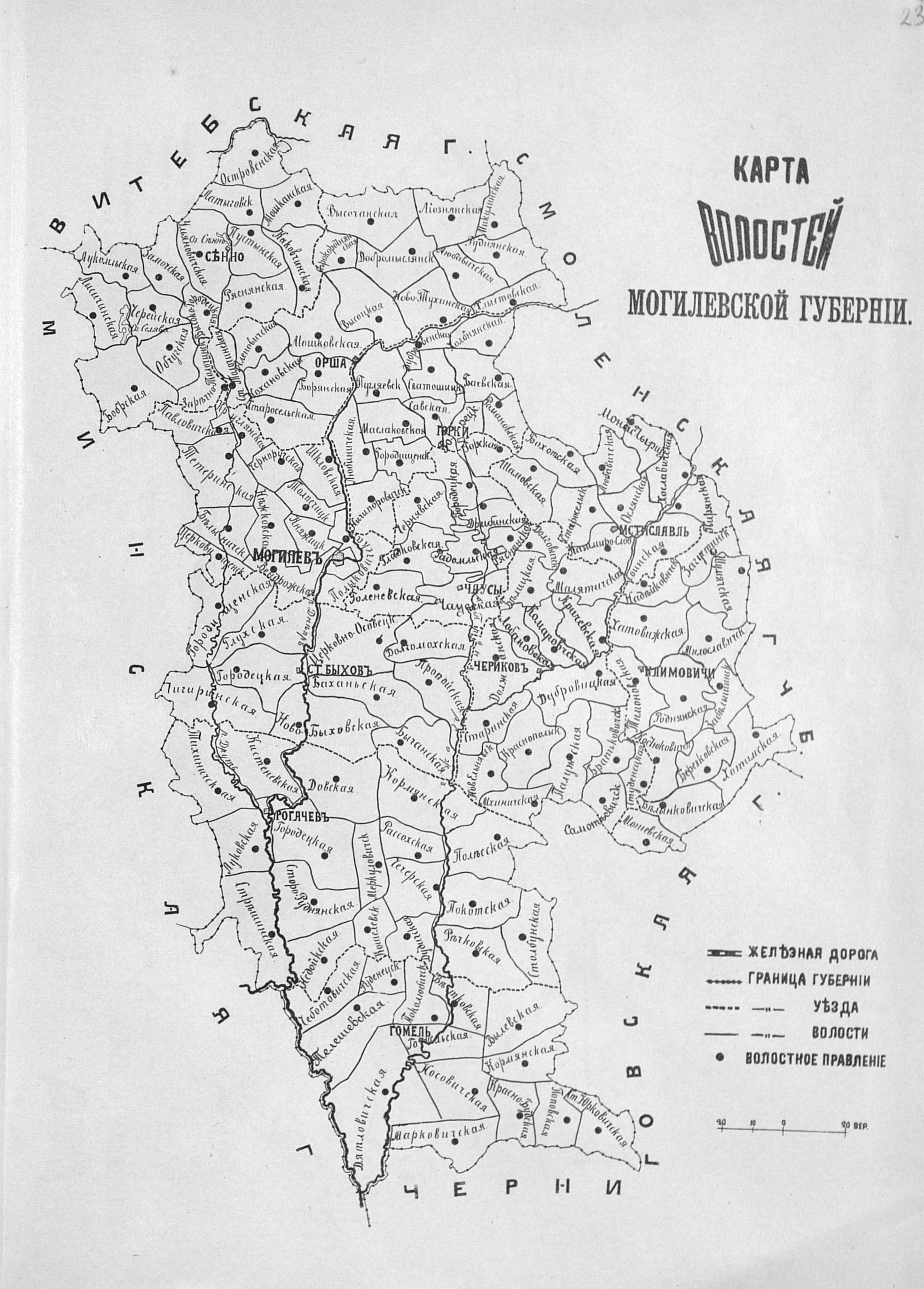
Source: Wikimedia Commons, public domain
One common trap: Bobruisk, today a major city of the Mogilev Region, belonged to the Minsk Governorate in imperial times. If your family came from Bobruisk, look for records under Minsk, not Mogilev.
Spelling the names
The same place can appear under several spellings, depending on who wrote it down and in which language. Search for all of them:
- Mogilev, Mohilev, Mohilew, Mahilyow, Mogilew and, in Yiddish sources, Molev;
- Bykhov, Bychow, Byhov, Bichov;
- Chausy, Chaussy, Chavusy, Chausi;
- Mstislavl, Mstsislau, Amtchislav in Yiddish.
Clerks at Ellis Island and in Buenos Aires wrote down what they heard. A town name that looks unfamiliar may simply be an accent turned into letters.
Where to start searching
Most records of the Mogilev Governorate are kept in the National Historical Archives of Belarus in Minsk and in the Mogilev regional archive. You can begin from home with large online databases:
- JewishGen, with its Belarus research division and town pages for the Mogilev region;
- FamilySearch, which holds filmed metrical books and census records from the region;
- Yad Vashem's Central Database of Shoah Victims' Names, for relatives who stayed and were murdered during the Second World War.
For news from these towns today, the independent outlet Mogilev.media publishes reports from every district of the Mogilev Region, in Russian and Belarusian.
Frequently asked questions about Mogilev ancestors
Short answers about the province, the districts, spelling, Bobruisk and where records are kept.
Is the Mogilev Governorate the same as today's Mogilev Region?
Not exactly. Most of it is, but Orsha and Senno are now in the Vitebsk Region, and Rogachev and Gomel in the Gomel Region.
My family document only says «Mogilev». Which place is it?
It may be the city, the district or the whole province. Look for a second place name in other documents, such as naturalization papers or gravestones.
Why can't I find my ancestors' town under any spelling?
Try transliterations from Russian, Polish, German and Yiddish. Clerks abroad often wrote the name as they heard it.
Was Bobruisk part of the Mogilev Governorate?
No. In imperial times Bobruisk belonged to the Minsk Governorate, so its records are filed under Minsk.
Where are the original records kept?
Mostly in the National Historical Archives of Belarus in Minsk and the Mogilev regional archive. Many are also filmed on FamilySearch.